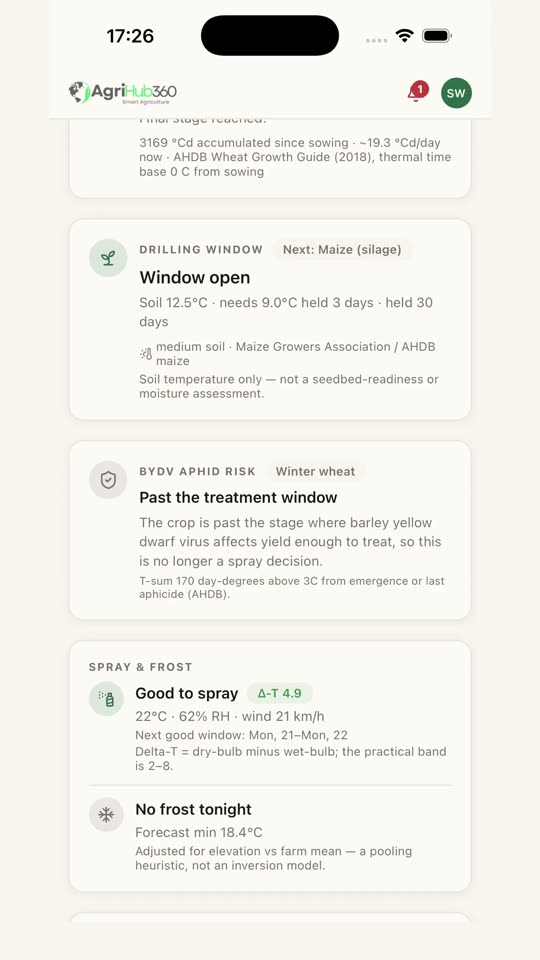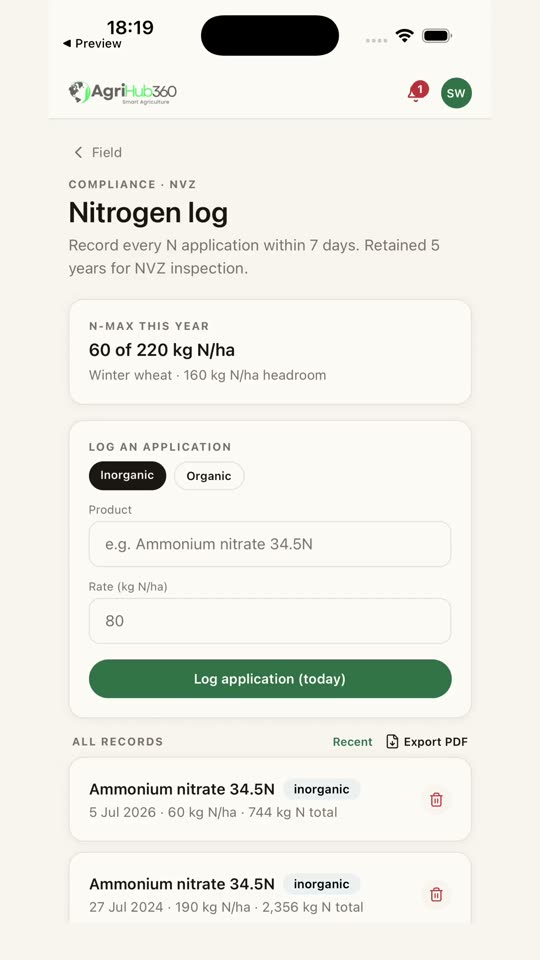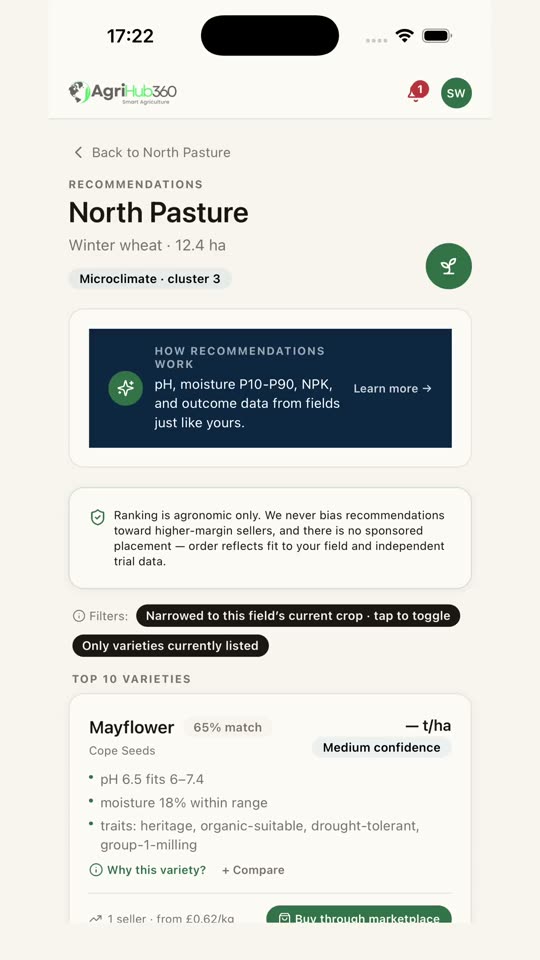
What it does for your field.

The kit underneath earns its place by doing four jobs.

  • You buy seed once a year and guess which variety suits the field.

    Seed ranked on your own microclimate, with predicted yield by variety.

  • A nutrient deficit found at harvest is found too late to save the crop.

    Live soil readings and plain-language alerts while there is still time to act.

  • Fertilising the whole field at one rate wastes both input and yield.

    Smart Fertilisation doses each field to what its own soil is short of.

  • EUDR, SFI and NVZ all want parcel-level evidence on demand.

    The same field record exports the proof, so you keep farming.

Look inside the kit.

Two-minute walkthrough
How a sensor becomes a recommendation.
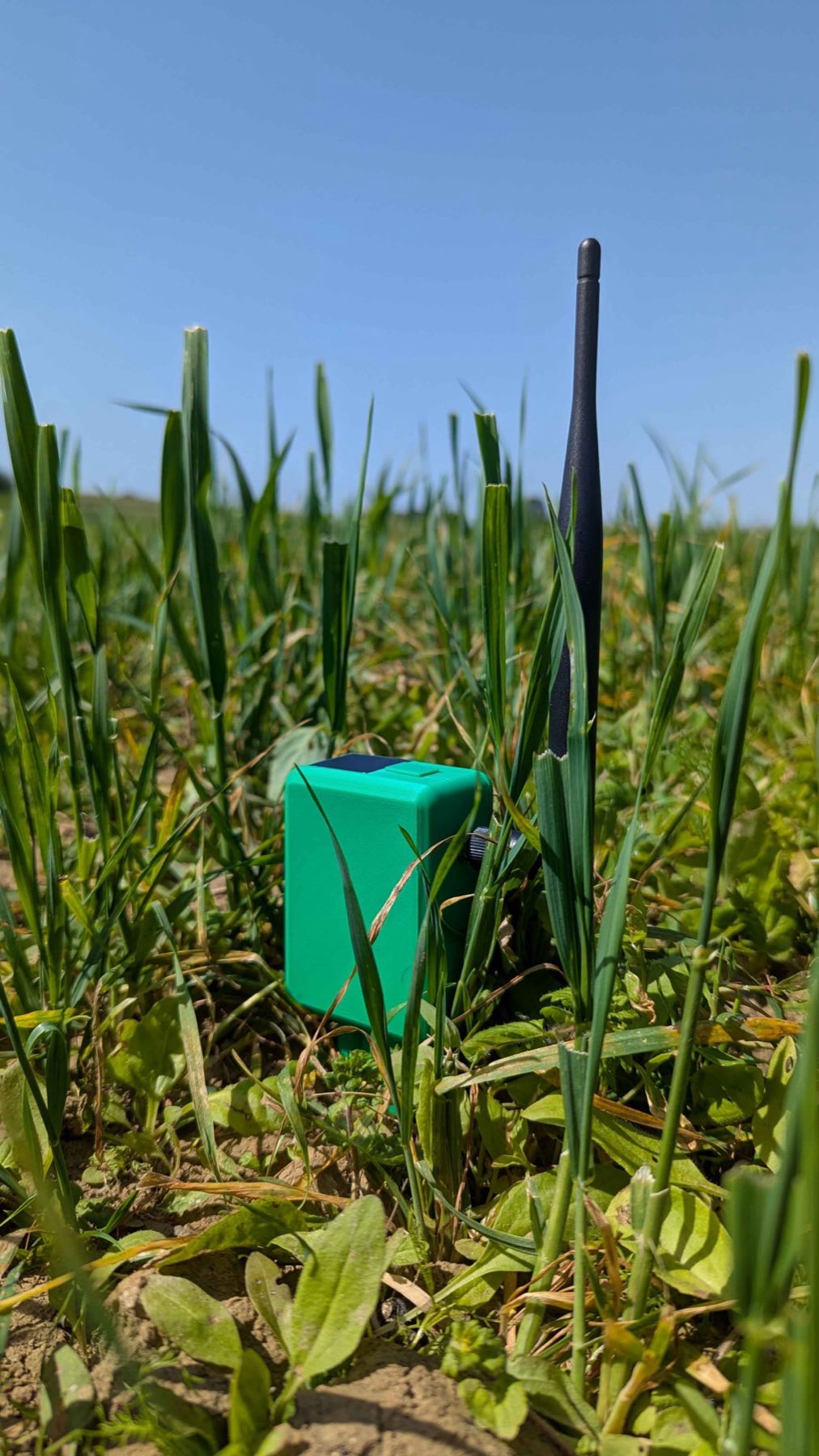
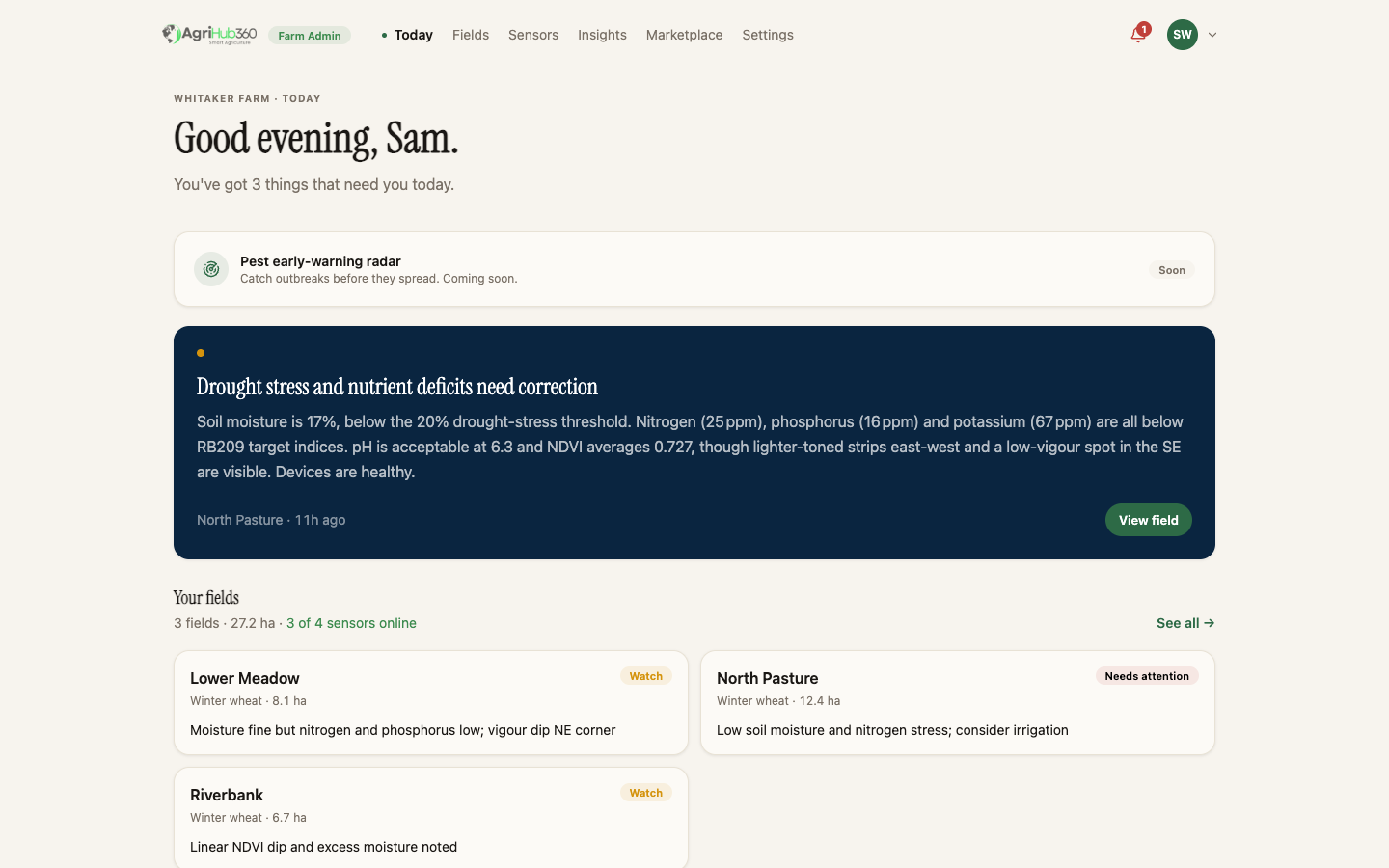
AgriHub360 solar-powered sensor standing among green wheat, antenna up
The sensor
Solar-powered and wireless. In the ground in minutes.
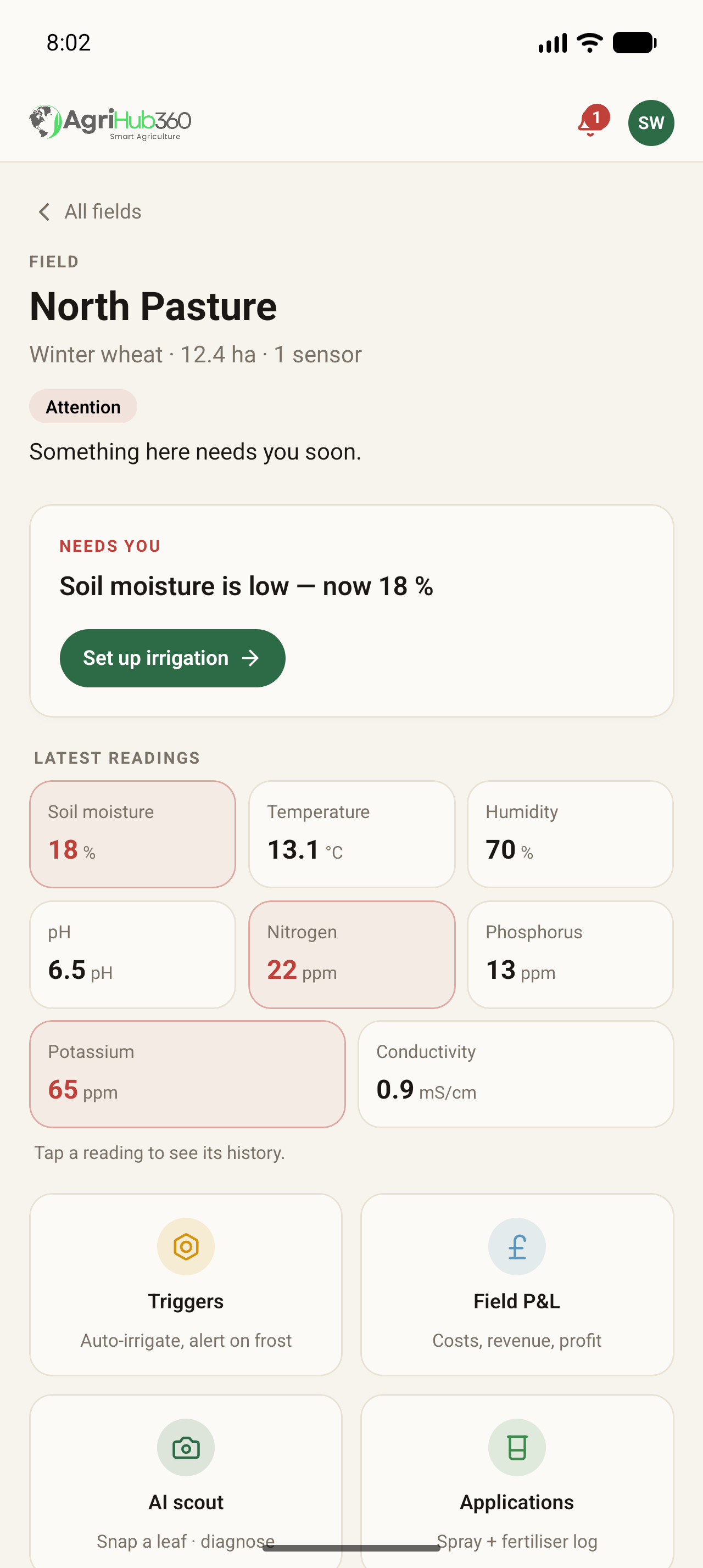
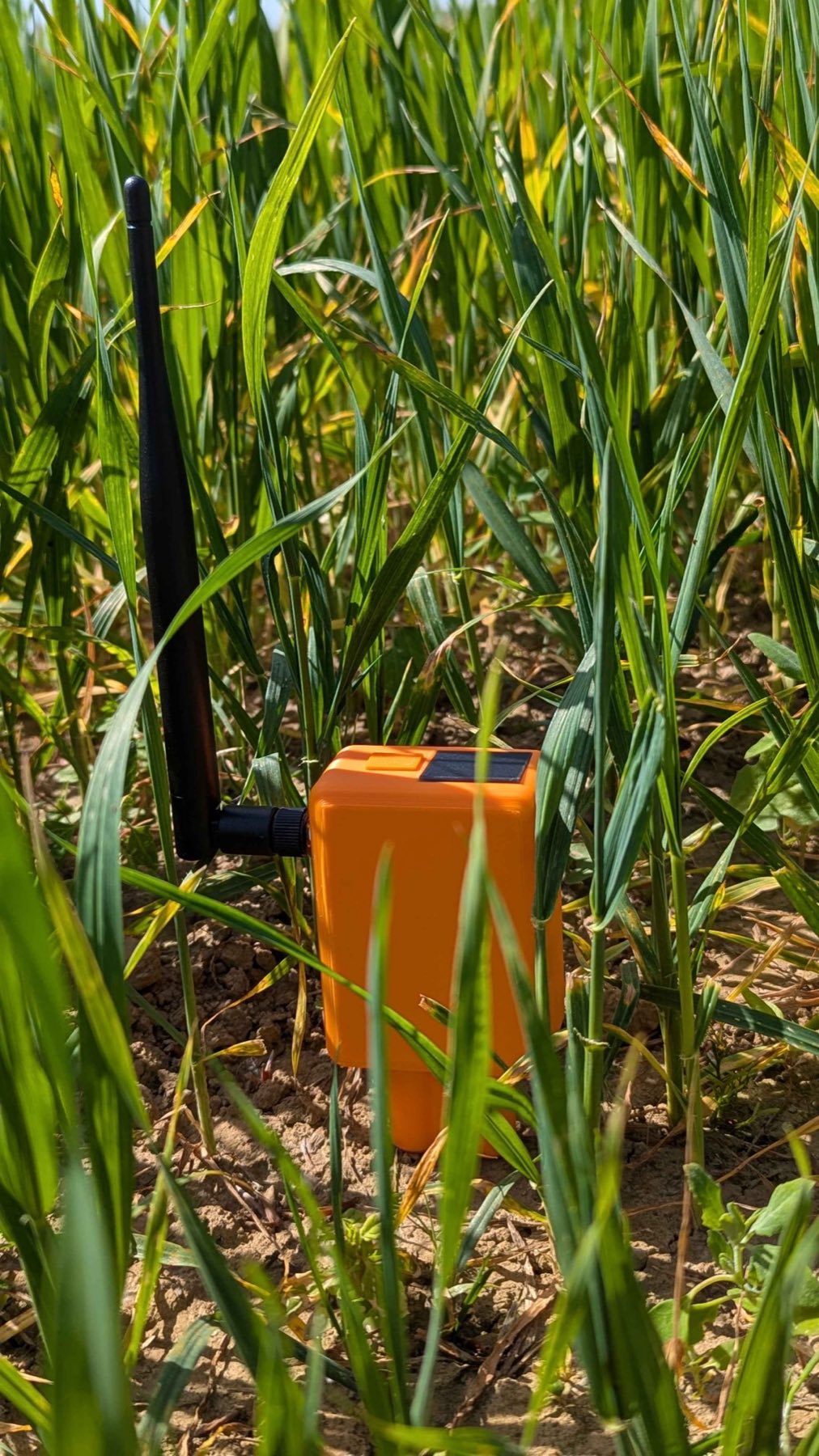
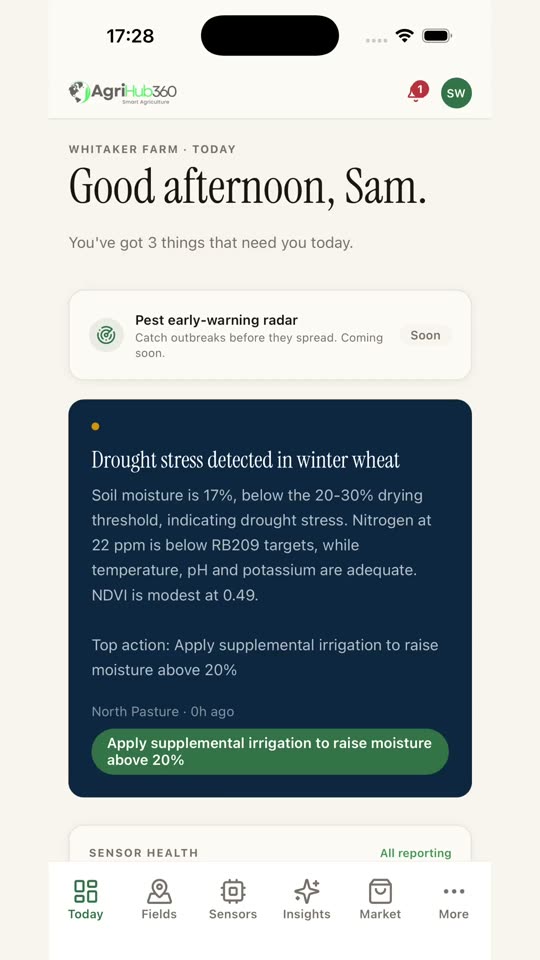
Alerts · this morning
Field 3 N low
Wheat ready · 3–5d
Rain incoming
On your phone
Same dashboard, in your pocket.
Live alerts · app.agrihub360.com
Field 3 nitrogen low. Fertilise within 48h.
Spring wheat ready. Harvest in 3 to 5 days.
Rain forecast. Irrigation paused.
The dashboard
Plain-language alerts instead of raw graphs.
Close-up of the orange sensor unit planted in the soil between crop rows
In the field
Built to live in the soil, season after season.
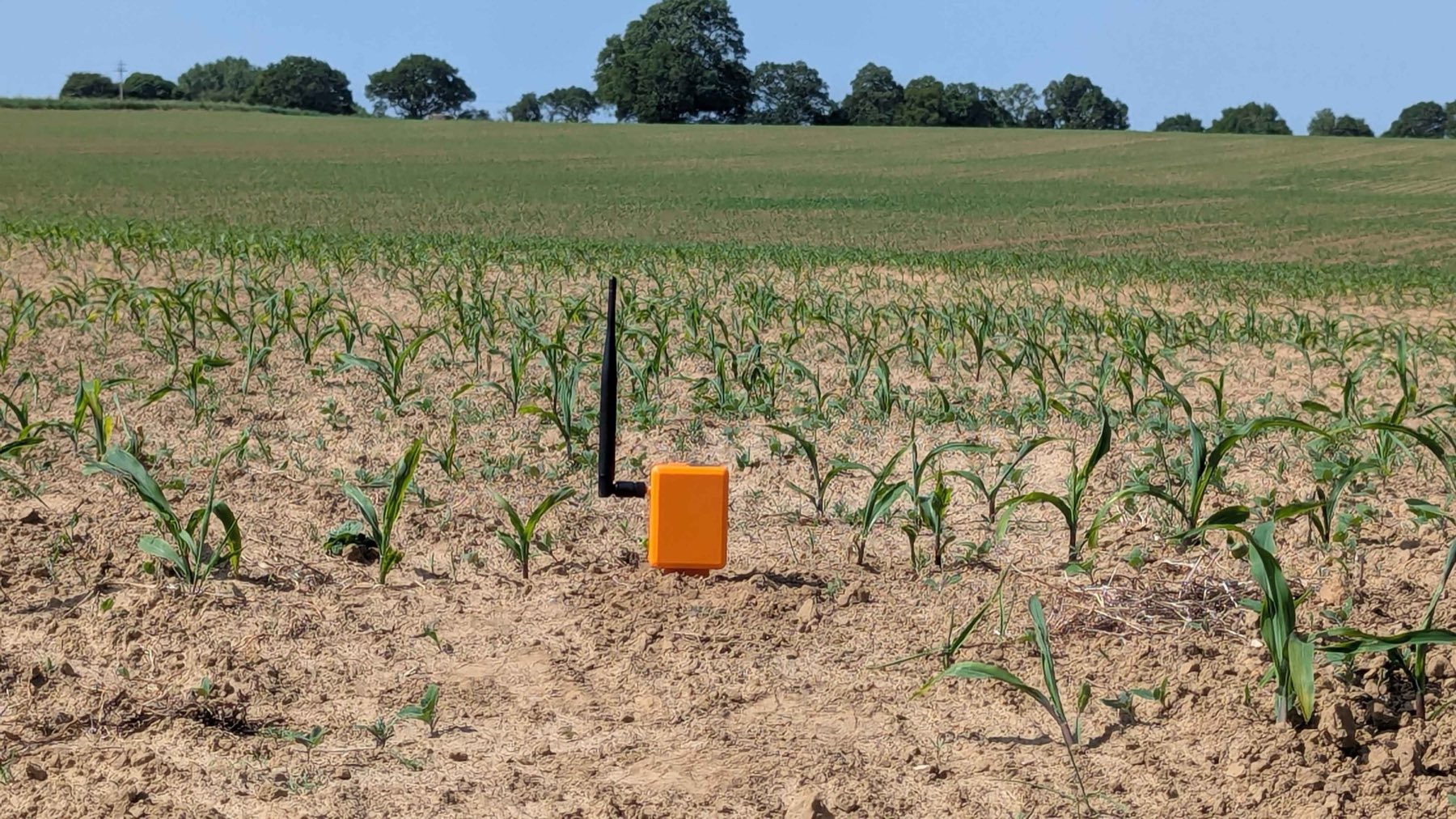
Wide view of a young maize field with an AgriHub360 sensor in the foreground
On a real farm
Pilot live on UK arable land.

From a soil reading to what you do next.

Four steps, no training course.

  1. 01

    Sense

    A probe in the ground reads soil moisture, nutrients, pH and temperature.

  2. 02

    Relay

    Readings travel over a solar-powered mesh to one gateway, with no wiring to lay.

  3. 03

    Analyse

    We track the trends and flag trouble before you would catch it walking the field.

  4. 04

    Act

    Plain steps on what to feed and when to water, with fertiliser and seed ready to order.

And the loop closes.
Yield plus sensor data updates next season’s recommendation for everyone in your microclimate.

Pick your microclimate.

Three fields. One system. A different answer for each.

Pick a farm, then a field. The variety ranking updates for that exact microclimate, the same way it does for pilot growers on their own land.

Semi-arid plateau. Long dry summers, low rainfall, high evapotranspiration.

7.8 pH avg
11% Soil moisture
24°C Soil temp
380 mm Annual rainfall
Best varieties for Orchard edge Predicted yield vs. a standard variety
  1. 1
    Avispa Agrovegetal
    Tolerates inconsistent shade and irregular water access.
    +15% high
  2. 2
    Soissons Florimond Desprez
    Heat-stable. Slight loss versus the open plain.
    +11% med
  3. 3
    Crusoe Limagrain
    UK-bred. Limited drought tolerance on this site.
    +2% low
See this on your land →

Demo data only. Your real recommendations are worked out for your own fields each season, from your live sensor readings.